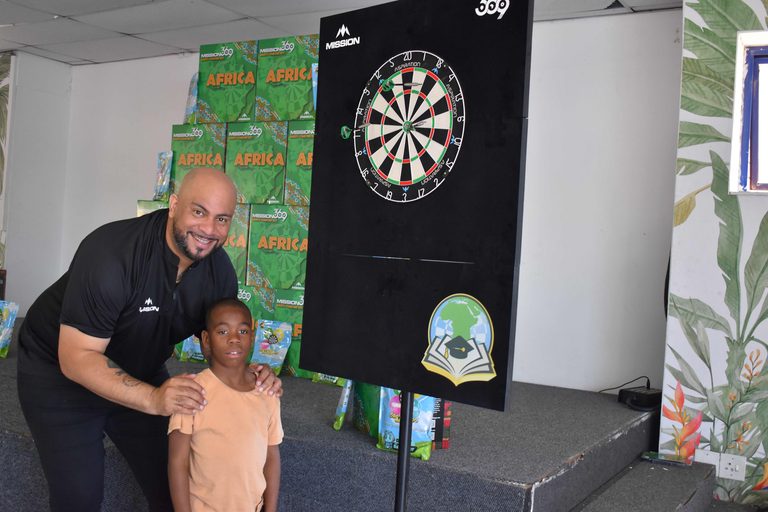
For many young learners, mathematics can feel abstract, intimidating, or confined to rigid textbook exercises. Yet, one of the most effective tools for building rapid mental arithmetic, numerical fluency, and strategic problem-solving isn’t found in a classroom workbook—it hangs on the wall.Inspired by professional darts icon Devon Petersen—Africa’s most successful pro darts player—Dartboard Maths is an innovative educational approach that leverages the focus, precision, and scoring mechanics of darts to make mathematics active, visual, and fun.
The Hidden Mathematics of the Dartboard
A standard dartboard is far more than a target for competitive sports; it is a dynamic numerical grid designed to test precision and mental calculation simultaneously.The board is divided into 20 equal radial sectors numbered 1 through 20, surrounded by distinct multiplier rings:
• Outer Ring (Doubles): Multiplies the sector value by 2.
• Inner Ring (Trebles): Multiplies the sector value by 3.
• Outer Bullseye: Worth 25 points.
• Inner Bullseye (Double Bull): Worth 50 points.
Because players start at a set score (typically 501 or 301) and must reduce their score to zero—finishing on a double—every throw demands instant mental arithmetic and ongoing tactical adjustments.
Core Educational Benefits of Dartboard Maths
1. Rapid Mental Subtraction and Addition
Unlike basic addition drills, darts requires constant subtraction from running totals under active decision-making. Players must continuously sum three dart scores and subtract that total from their remaining score..
2. Times-Table Mastery via Multipliers
Reaching high scores relies heavily on the treble ring. Repeatedly calculating 19 × 3 = 57, 18 × 3 = 54, or 17 × 3 = 51 reinforces multiplication facts through practical application rather than rote memorization.
3. Strategic “Checkout” Combinatorics
The closing phase of a game requires strategic planning known as “checkout routes.” If a student has 82 points remaining with three darts, they must analyze multiple pathways:
• Route A: Treble 14 (42) leaving 40 (Double 20 / “Tops”).
• Route B: Bullseye (50) leaving 32 (Double 16).
4. Building Numerical Confidence Beyond the Desk
Movement-based learning breaks down anxiety for students who struggle in traditional desk environments. Working with tactile targets and visual scoring grids bridges the gap between concrete activity and abstract mathematical reasoning.
Bringing Dartboard Maths into the Classroom
Implementing Dartboard Maths in a learning environment doesn’t require sharp steel-tip darts. Safe magnetic boards or interactive digital scoreboards allow educators to structure a range of activities:
• Target Subtraction Drills: Begin at 100 or 200 to focus purely on rapid subtraction and double finishes.
• Factor and Multiples Games: Challenge students to reach a target number using specific multipliers (e.g., hit two doubles and one single to equal 36).
• Probability & Geometry Analysis: Explore board geography, calculating the area of high-yield scoring regions versus the risk of hitting adjacent low-value sectors (like the 1s and 5s flanking the 20 sector).
For a deeper look into this initiative, watch How Africa’s Best Darts Player Is Making Maths Fun for Young Learners. This video highlights how professional darts player Devon Petersen uses the sport to boost numerical confidence and concentration in young students.